
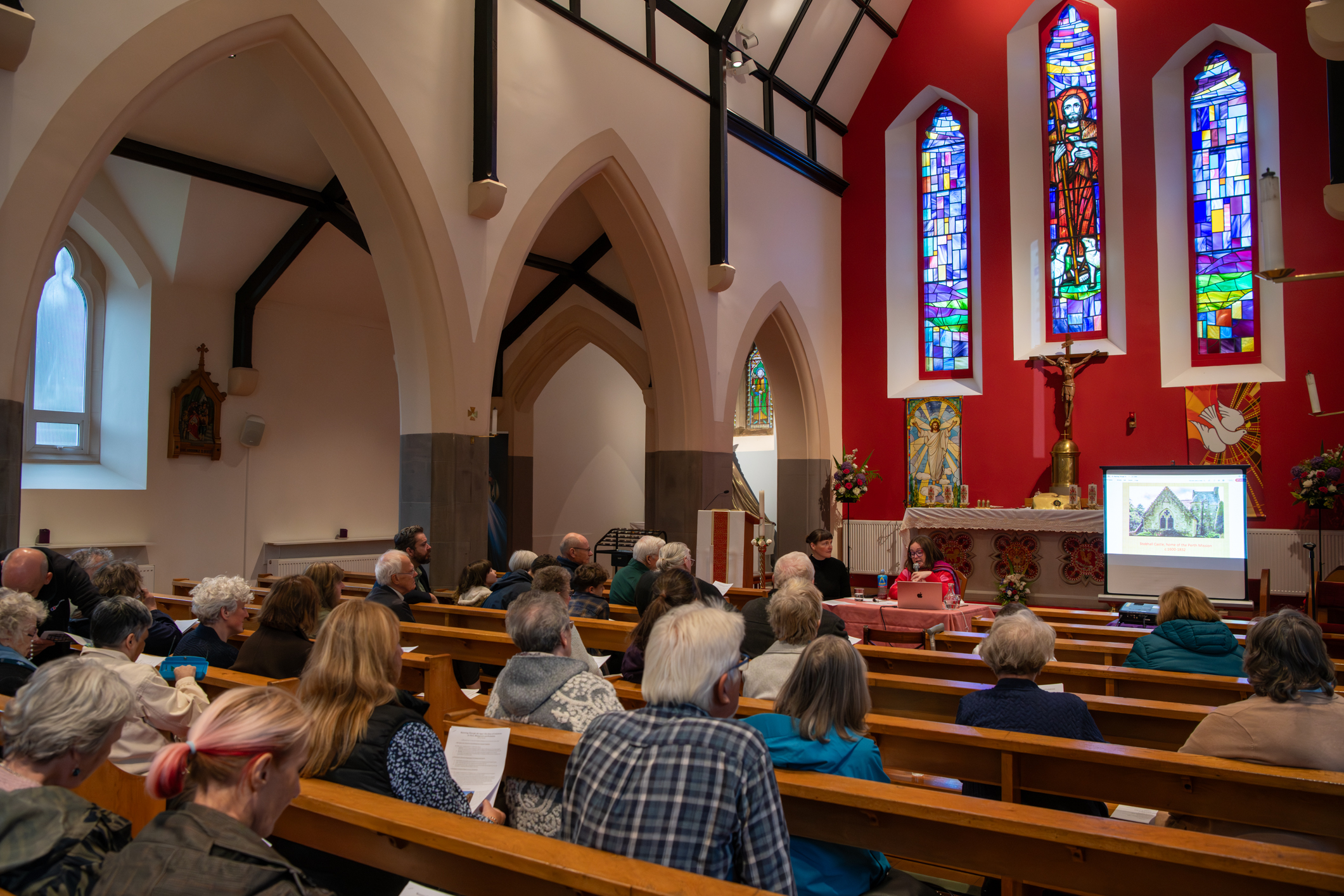
St Stephen’s RC Church, Blairgowrie enjoyed a fascinating journey through 1,500 years of Perthshire’s Catholic history on Friday evening as Medievalist Dr Kylie Murray delivered a special lecture marking two significant local anniversaries: the 175th St Stephen’s Church and the 125th of St Luan’s Church, Alyth.
Entitled Rejoicing Through the Ages: The Story of Catholicism in Alyth, Blairgowrie and Perthshire, the illustrated talk began with the hidden survival of post-Reformation Catholic worship through landed estates including Stobhall and Murthly. The latter became the base of Fr James Mackay (d.1884), who was the founding father of St Stephen’s Parish.
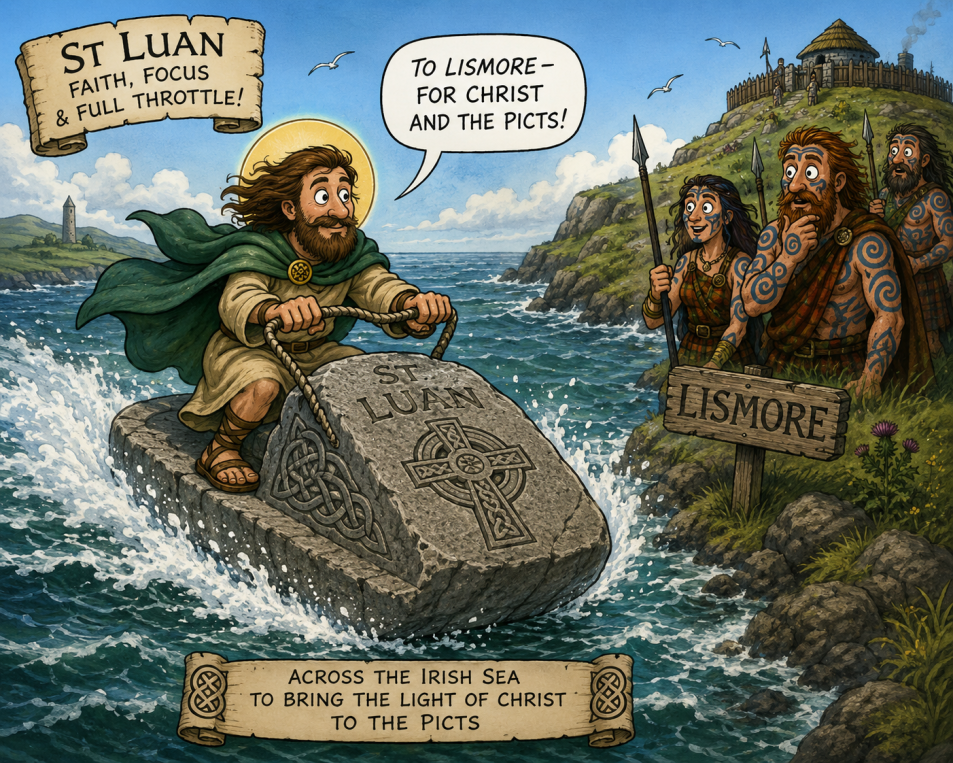
The lecture then explored the 6th century story of St Columba (521-97 AD) patron Saint of the Dunkeld Diocese, and his contemporary St Moluag, known locally as St Luan (c.520-92 AD). A memorable moment came when Dr Murray retold the famous account from the Latin Aberdeen Breviary (1510) of how St Luan, after being left behind in Ireland by fellow missionaries, was miraculously carried across the Irish sea by a stone, ‘faster in motion than the ship, and arrived before the rest of his companions’, akin, Dr Murray said, to a ‘rocky surfboard or e-scooter!’
‘A thing happened which is seldom heard of: when he had prayed, the stone upon which Luan had set his feet, quite firmly fixed by nature, divinely carried him across the great breadth of the ocean, faster in motion than the ship, and he arrived before the rest of his companions at the port of the church of Lismore which he had desire. And there, that stone, which is unlike the rest of the rocks on that island, ceased from motion.’
(English translation from the Aberdeen Breviary, 1510).
Exploring the saint’s enduring legacy, Dr Murray examined evidence linking St Luan to Alyth, including the historic Alyth Arches, believed to stand on the site of an early church associated with the saint.
Evidence of St Luan’s presence in Alyth points to the earliest evidence of Christian worship in Perthshire, centuries before St Columba’s relics arrived in Dunkeld (849 AD).
The lecture also shed new light on the exciting yet overlooked role of Coupar Angus Abbey, founded in the 12th century as part of the international Cistercian network. Dr Murray showed two manuscripts in the Vatican Library which came from the Abbey, and revealed Perthshire’s place within wider European intellectual and religious traditions. She also shared a unique version of Bower’s Scotichronicon, Medieval Scotland’s largest text, which includes an extraordinary vision of William Wallace receiving a sword from St Andrew, Scotland’s patron saint.
Concluding her lecture, Dr Murray paid tribute to pioneering priests including Fr James Mackay and Fr Carmont, who between them established a permanent Catholic presence in Blairgowrie. The construction of St Stephen’s Church (1856), designed by renowned Gothic Revivalist architect Edward Welby Pugin, and the later establishment of St Luan’s Church, Alyth (1900). Dr Murray highlighted the remarkable fundraising efforts of local Catholics, particularly Sergeant Murray, who singlehandedly fundraised the building costs of St Luan’s.
Concluding the lecture, Dr Murray reflected on the stained-glass windows of St Luan’s, depicting St Luan, St Margaret of Scotland, St Andrew and Blessed Duns Scotus, symbolising the rich spiritual and cultural heritage that continues to inspire local Catholics today.
Describing the anniversaries as ‘Janus-like’ looking to the past and future, she encouraged those present to celebrate the achievements of previous generations while looking to the future with confidence, hope and joy.Fr Gregory invited all those present to explore ways in which the illustrious and inspiring heritage shared by Dr Murray could be carried forward by the church today. A vibrant discussion followed, with many questions from the floor. One contributor suggested these new findings could invite fresh approaches to the Scottish school curriculum to foster greater understanding of the endeavours of our forefathers.