
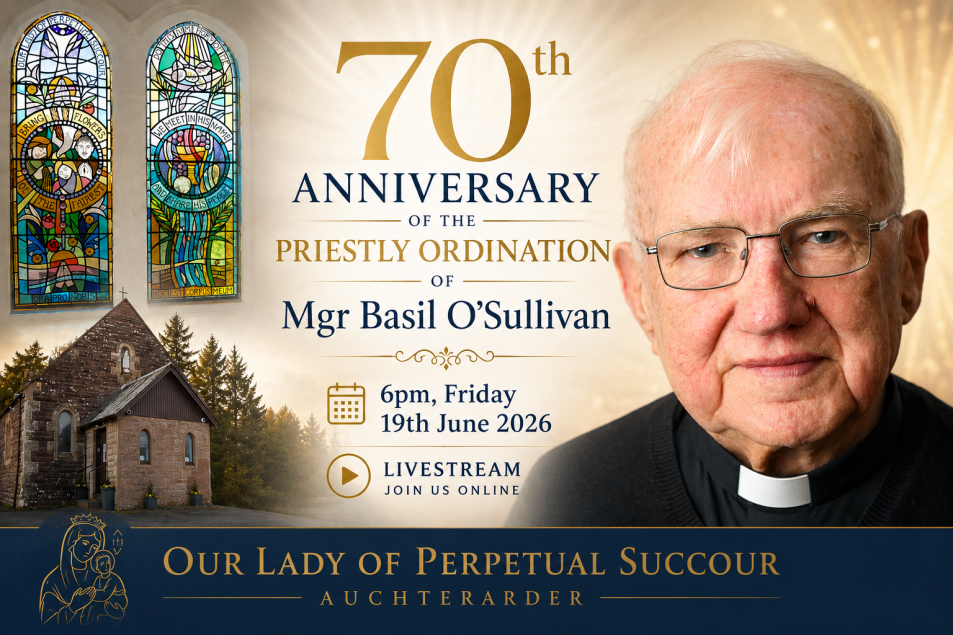
Monsignor Basil O’Sullivan, parish priest of Our Lady of Perpetual Succour in Auchterarder, celebrated his 70th anniversary of ordination to the priesthood on 17th June 2026, a remarkable and special achievement and cause for great rejoicing and thanksgiving in our diocese. Ahead of the anniversary Mass and celebrations, Dunkeld News sat down with Monsignor O’Sullivan to talk about his life and ministry, from childhood in Ireland through to the present day here in our diocese. What follows is the full interview, an excerpt from which is published in the current issue (Issue 4) of the Dunkeld News.
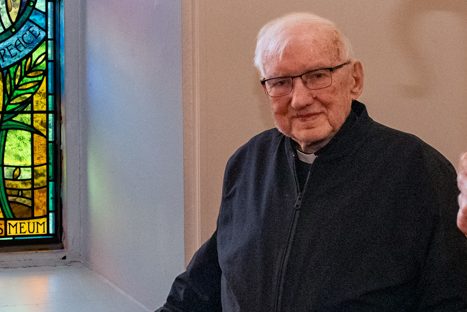
Interview with Monsignor Basil O’Sullivan
I was the youngest of nine children, born in 1932 in Wales, but I don’t remember living there. I was taken back to Cork, as a baby, and all the rest of my siblings were born and brought up in Cork.
My education began with the Christian brothers, in the North Monastery in Cork – that was in my primary school years – and then I went on to the diocesan college, called Farranferris, which was kind of a high school, but in the hope that people would become priests as well, and it was indeed a great source of vocations for the priests, especially for the diocese. A bit like Blairs College but not quite so clerical. Anyone could go there and you didn’t have to become a priest to end up there, but it was the best place to be educated.
There was lots of religion – the Catholic environment was very strong in those days in Cork. It was a very strong community, and it was mainly during the war, of course, in which I was brought up; the period of childhood I remember best would be the 1940s.
I had two older brothers in the war, which, of course, affected us greatly as a family. We discussed events that were taking place in the world, and there was a lot of stress for my parents with two boys out in the war. They couldn’t even write letters home! One brother was in the RAF, seeing active service in North Africa and Italy; the other was, just as dangerously, in the Merchant Navy – he was sunk three times, but he lived to tell the tale, thankfully! That affected the way we related to the war, especially, as I said, for my parents. I was only a child, but never a night would pass without thinking about my two brothers. In those days, we had the Rosary every night after supper at 6’o’clock, even before the dishes were done. We all met to say the Rosary, and we took it for granted to recite the Rosary then.
In those days interestingly enough, unlike today, the person in charge of the Rosary – my mother, of course – she didn’t give out the intentions at the end, what is known in Ireland as the trimmings. There would be three or four of them (and for each you would pray one Our Father, three Haily Mary’s and a Glory be) but they would never announce what the intention was. She never said so, but I’m pretty convinced that one of the trimmings was for the two boys in the war. But that was never mentioned. I actually told one of my brothers after the war that we were praying for them both every night and he was quite affected by that.
After the war, I attended St. Finbarr’s College in Farranferris, run by the diocese. I was very happy. It was quite a small school compared to the big high schools around the place, around 100 pupils. Some were boarders because they were farmers’ sons. But I lived near the college, so I was what was called a day boy; I made very good friends there. It was, of course, deeply religious and all the teachers were priests. I can’t tell you when actually I first thought about becoming a priest, but it always seemed to be in my mind.
I was very taken with a local church run by the Dominicans, maybe a mile or two away from my home, and they ran a noviciate. I was taken, I have to say, by the glamour of the way they were dressed, more like medieval knights than monks in robes! Yes, it was quite a big community and one of my friends, he became a Dominican, so I did consider it. But a relative of mine, my sister’s brother-in-law, became a student at All Hallows College in Dublin, a prominent seminary founded by a curate, John Hand, in 1842 to train Catholic priests for missionary work in English-speaking countries where there were shortages of priests. This was my first encounter with All Hallows and it was this idea of serving where there was a shortage of priests that appealed to me.
The headmaster at St. Finbarr’s invited me to go forward for priesthood in Cork Diocese but I liked the idea of leaving Ireland and going overseas. and as I said, this relative of mine went to All Hallows and I was taken with what he was able to say about the college and the mission. Yes, it didn’t seem to matter where you went, as long as you be became a priest: the priesthood was the main attraction of going there. And so I eventually joined All Hallows in 1950 after leaving school.
There were lots of young men at the college and there were 30 in my class. I really didn’t know where in the world I was going to go because then you had to get a diocese to take you over. It was, I suppose, kind of a marketplace! The rector would be in touch with bishops all over the world. One day – I wasn’t long there, maybe a month or so – and the rector came to me and said there was this bishop over from Scotland. I had mentioned the fact that I had connections with Scotland because an auntie of mine was a teacher in Glasgow. She had always talked about shortages of vocations in Scotland – we’re still talking about the 1950s here. This bishop met me, interviewed me (and another student as well) and he turned out to be the bishop of Dunkeld – he signed us on, and that was important because that’s how we stayed in the college. You couldn’t stay in the college without a diocese to go to because the college wasn’t geared for the Irish dioceses. Many went to America and quite a few went to England. When I mentioned Dunkeld to my friends, nobody knew where it was. And one bright spark said it’s a fishing village. And that’s all I knew about the diocese for six years!
Eventually, I was ordained, supported by my family because the family had to provide the financial support. In those days, it wasn’t the affluent society we have today. There weren’t two cars outside the door and holidays in the Canary Islands. And when you left school at 18, you were expected to get a job and contribute to the family. So, even though they kept me going, it was quite hard for them to do so. For six years, they had to help with pocket money, books, clothes and various expenses you have. The fees were paid for by the diocese, but everything else was paid for by my family – they took a little weekly collection in the family to keep me going.
I was very happy at the college, although it was very strict, much stricter than it would be today, I think; very much run by the rules. The professors were very holy, and I was very grateful to them for the Vincentian spirituality.
It might sound a bit daft now, but there was of course no mention of Vatican II then. In the 1950s, Pope Pius XII was on the chair of St. Peter, and the Council of Trent was what ruled us. Everything was in Latin, even the textbooks! I suppose the lectures were said in English and Latin, but certainly the textbooks were in Latin and, of course, the whole liturgy, Mass and all that, that was in Latin as well. But I was very grateful to them because they I felt that there was a wonderful training and spirituality. And one of the professors said to us, we’re not really trying to make you into experts, but working priests in the parishes, that was the ambition. Not scholarship, but educated working men for the parish that we were going to.
You can see the picture of my class there on the wall. About 12 of them went to the United States, 10 or 11 went to England, 3 or 4 came to Scotland and another 4 or 5 to Australia – a truly Catholic apostolate! I was ordained by the bishop, who was one of the former students at the college. I think he came from one of the Pacific Islands. The sad thing, of course, was that we’d hardly ever see each other again, because of the distances. They didn’t have Facebook then – you couldn’t just pop on and send a message; no texting. The guys who flew out to America, I think it took them 3 days of flying just to get there, via Iceland and Canada, so it was a long journey for some.
I think something that we all experienced, I suppose, was a great sense of loneliness when you arrived, far from home. Even though Scotland was English speaking, it was certainly a strange land, and there was a sense of being cut off, especially with having no facility to go home. We had spent six years isolated in the college, not really knowing the world. Suddenly you were parachuted into a new place and trying to make your way, trying to find your feet and adapt to a new form of life, which we couldn’t properly train for. Living in a college is very different from living in a parish house! But, in any case, I received nothing but kindness and help
After some time, the bishop said to me that he wanted me to go to Rome, to study canon law. And of course, if the bishop says you go, you go! I was ordained in 1956, and in September 1957, I was sent out to Rome to the Gregorian University. The first year, I stayed in the Scots College at the Quattro Fontane. It was a great honour to be at Rome and studying at the Gregorian University, but it was hard going, too, because the lectures were all in Latin. There must have been 60 or 70 priests in our class: all priests starting cannon law, and all different nationalities, totally different. I remember before the Christmas holidays, we all wrote happy Christmas to the professors. in our own languages. There must have been 25-30 different languages on the blackboard, wishing the professors happy Christmas!
It was a great experience, and being in Rome itself, of course, was also a great experience. It so happened that Pius XII died during my time there, so it was great to be there for the big events, like the inauguration of John Paul XXIII.
The Scots College building was on its last legs and the bishops, in their wisdom, decided to build a new college in a new settlement of the Roman suburbs. They could see the current college had been neglected during the war – indeed, just before the war started with Italy, the British Ambassador came to see the rector of the college and said to get out of here quick. That was a bad time for them, trying to escape Italy and getting home in the middle of the war! The decision to build a new college was made when I was a student there. I finished my course in Canon Law in 1959 and then came back to the Diocese of Dunkeld, so normal life took over after that.
In my first few years, I was sent to Dundee, and I was a curate at St. Joseph’s, and a curate at the Cathedral, and then eventually, I was appointed to Alva, as the parish priest. This was after 15 years or so. In those days, you waited 15 years to get a parish! And then one of my big appointments was being sent to St. Columba’s in Kirkton. I was there for a long, long time. It was in a housing scheme, and it was very challenging, but I was delighted to be there. They were lovely people and very supportive.
In 1987, I was sent to Dunblane and I spent most of the rest of my life there, over 30 years! It was, again, a very happy appointment. Except for the sad event that was so infamous – the Dunblane Massacre. We were there that day for the shooting. It was very difficult to handle all that, but the Lord had me, and the parishioners, they were very supportive. The other clergymen had wives to support them, but of course the priests don’t have any, but the parishioners rallied around me.
The publicity was enormous – the world’s press was outside the door, and you never knew, if they knocked on the door, who it was going to be, whether it would be CNN, the BBC or someone else to interview you. There was huge pressure from the publicity point of view, but of course there was also the trauma of dealing with the people who had lost children. The whole thing is almost impossible to describe. I was involved in all sorts of meetings, especially organising the funerals, visiting the parents and the bereaved, as well as the children who had been injured. Having to deal with all that was very demanding: in the middle of the trauma, you couldn’t sleep and you couldn’t eat. I think this was true of everyone in Dunblane. When you went into the supermarket, it was like going into a cemetery. It was so quiet, and you could see people’s face were drawn. They weren’t sleeping and the whole town was traumatised.
The church became the focal point, especially when it came to the funerals. I had three little children who were killed, and we had to deal with those families. I didn’t bury one child, as she was buried elsewhere, but I buried two and that was very demanding because you wanted everything to be right, but the publicity was enormous. This was stressful because anything you said was worldwide the moment you said it. If you said something inadvisable, it could be quoted in Sydney within seconds. I always tried to make sure I said nothing that was insensitive when I was being interviewed as I didn’t want the victims to have to relive that.
In many ways, the Dunblane Massacre formed a great trauma in my life because I still have aftereffects. I’m still known as the priest of Dunblane, and I was back there a few months ago to say the Mass for the 30th anniversary of the event. So that has coloured my life ever since.
The bishop asked me to take over this place (Our Lady of Perpetual Succour in Auchterarder) because there was no priest here. I was priest at Dunblane and Auchterarder for the best part of 25 years, I think. Eventually, when I was getting old, I asked the bishop if I could stay here in Auchterarder and that’s where I am at the moment.
Even though the church has, in some ways, changed, in other ways it has remained the same. We still have the Sacraments; the language of the church is different now, but that’s only an accidental. Our tradition, which has been around for 20 centuries, has proclaimed the same doctrine, and the same teaching, and the same values. Fashions may come, and fashions may go, but the standards that have been taught by the Church from its earliest days, even from the days of the New Testament, up to the present day, have lasted. The Church gives a person great stability of life if he or she is faithful. It is very important for people to know what the teaching of the Church is, to understand a little bit – they don’t have to be theologians or experts. But for their own happiness, they need to know what it is about. They need to know why it’s so wonderful that this pearl of great price, as Jesus called it, has lasted in the teaching of the Church, and brings happiness to people, even though part of it is carrying the cross, but that itself is inevitable as well. We all have to carry a cross, whether we like it or not.
In the 1960s there was an attitude of anything goes – that affected the church as well, and we’re still feeling the fallout from that now. A lot of people fell away, and we don’t have the big congregation we had then. But I think people are more committed now. And they’re also more aware of the Church’s teaching and more conscious of the liturgy. In the old days, they might just turn up to Mass and pray the Rosary, so I think we’re better for that.
But we do have smaller congregations, and certainly the vocations have dropped off. When I was young, when I came here in 1956, just about half the priests in Scotland were Irish trained. And now there’s nobody like that. And then, for a short while, we had lots of Polish priests, and now we have lots of Nigerian priests: different nationalities but still blessed with lovely priests, they’re just coming from a different place. It’s sad that we don’t have the same number of vocations from Scotland but I’m hoping that that will change with time.
I think for a young man now, in the age in which we live, which is a very permissive age, it is a big commitment for a young man to decide to be a priest. It’s not what his friends are doing and relationships between the sexes has been revolutionised since earlier times. And that makes vocations much more difficult.
Ever since I was a teenager, I wanted to be a priest and I’m very blessed by God that I was able to carry it out. I was able to come to this beautiful diocese, and I was treated well by the Lord, our clergy and parishioners in a wonderful way! It has been a very happy relationship with all of them, and I have to say how blessed I was in in coming to Diocese of Dunkeld as a priest. I have no regrets and I couldn’t imagine myself being anything else.
It’s been a wonderful life and when you know that you’re doing what God wants you to do, in that sense, there’s nothing to take the place of that. Whatever sacrifices and difficulties you encounter on the way, if you have been called by God to be a priest and are faithful to that, then you don’t have any regrets of any kind; nothing but gratitude for your life.
That’s the end of the story. Well, hopefully, not quite yet!